
Reviewed by Richard Dawson, DMD — General & Implant Dentist, ICOI Fellow, Smile Science Dental Spa
Conventional Dentures: What You Are Getting
A conventional complete denture is a removable acrylic appliance that replaces all the teeth in one or both arches. It rests on the soft tissue of the ridge and is held in place by suction, adhesive, and muscular adaptation. Conventional dentures are less expensive than implant-supported options and require no surgery, making them accessible for patients who are not surgical candidates or who have financial constraints.
The limitations of conventional dentures are real and affect daily life. They move during eating and speaking, particularly the lower denture, which has less ridge surface for suction and is displaced by the tongue. Adhesives help temporarily but do not restore the stability of anchored teeth. Over time, the jaw bone that once held teeth resorbs in the absence of stimulation, shrinking the ridge that the denture rests on. This progressive resorption is why dentures need relining and eventually replacing, and why long-term conventional denture wearers develop a sunken facial appearance that is a result of bone loss rather than simple aging.
Chewing efficiency on conventional dentures is a fraction of natural teeth. Studies have documented reductions of 50 to 80 percent in bite force compared to natural dentition, which affects both diet selection and nutritional status. Patients on conventional dentures consistently self-limit to softer, easier-to-chew foods, often at the expense of dietary variety and quality. Understanding these limitations honestly before choosing a denture helps patients make a decision they will not regret in three to five years when bone loss begins to affect fit.
Implant-Supported Overdentures: The Upgrade
An overdenture is a denture that attaches to dental implants. The most common lower-arch design uses two implants with locator abutments; the denture snaps onto the implants and is removed daily by the patient for cleaning. The upper arch, with less favorable bone density and more anatomical complexity, typically benefits from four implants for comparable stability.
The benefits over a conventional denture are significant. Implant attachment eliminates most denture movement during eating and speaking. The patient gains meaningful confidence in daily social situations. Bite force improves substantially. Just as importantly, the implants stimulate the bone around them, dramatically slowing or halting the resorption that is the long-term enemy of conventional denture wearers. The implants themselves preserve ridge volume so that the overdenture continues to fit well over years rather than requiring repeated relining.
Implant overdentures do not eliminate all the characteristics of removable appliances: the patient still removes the denture nightly, the palate is still covered (for upper arch designs), and the attachment components require periodic replacement. But compared to a conventional denture, the improvement in retention, stability, comfort, and bone preservation is substantial enough that most patients who upgrade describe it as transformative. For patients interested in comparing overdentures to fixed alternatives, see our detailed comparison of snap-in versus fixed implant dentures.
Who Should Choose Which?
The decision between a conventional denture and an overdenture involves medical, financial, and lifestyle factors. For most patients who are reasonably healthy and do not have a specific medical contraindication to implant placement, an implant-supported overdenture provides better long-term outcomes and should be discussed as the preferred option when finances allow.
Conventional dentures are appropriate when: the patient cannot safely undergo implant surgery due to medical conditions, when financial constraints make implants impossible even with financing, or as an interim appliance during healing before implants are placed. They are also appropriate for patients who have clear preferences for avoiding surgery. These are legitimate choices, and a good dental provider presents them honestly without pressuring any patient toward a particular option.
Overdentures are more appropriate when the patient wants better stability, is willing to have a minor surgical procedure, has adequate bone to support at least two implants in the lower arch, and wants to protect their bone long-term. The investment in implants now reduces the total cost of denture care over a decade, since ridge resorption under conventional dentures requires more frequent relining and replacement. Most patients who choose an overdenture, when offered both options, do not return wishing they had chosen the conventional denture instead.
Let Us Help You Choose the Right Path to Stable Teeth.
Dr. Dawson evaluates bone volume, your health history, and your goals to give you a personalized recommendation that balances function, longevity, and realistic cost. Book a consultation today.
The Transition from Teeth to Dentures
Regardless of whether you choose a conventional denture or an overdenture, the transition from natural teeth involves a physical and psychological adjustment period. Speech temporarily changes as the tongue and lips adapt to the new prosthesis. Eating requires relearning how to distribute biting forces across the denture base rather than through individual teeth. Most patients adapt within 4 to 8 weeks for basic function; confidence in social eating and speaking may take longer.
Immediate dentures, placed the same day as extraction, allow the patient to never be without teeth but require more adjustments and relining as healing and resorption occur over the subsequent 3 to 6 months. A definitive final denture or overdenture is typically made after initial healing is complete. For patients having all teeth removed in anticipation of implants, a transitional immediate denture can serve as the removable appliance during the healing period before implants are placed or loaded.
Psychological adjustment is real. Tooth loss has documented effects on self-image and quality of life. Choosing a prosthetic solution that provides stability and appearance confidence is not a luxury; it is part of the outcome that patients deserve. Research consistently shows that implant-supported overdentures produce higher patient satisfaction and quality-of-life scores than conventional complete dentures, particularly for the lower arch where stability is most challenging with a conventional removable appliance. For patients who wear full dentures and experience significant instability, an evaluation for implant support is a worthwhile next step regardless of how long they have been in conventional dentures.
Frequently Asked Questions
Here are quick answers to common questions about conventional dentures versus implant overdentures.
- What is the main difference between a denture and an overdenture?
A conventional complete denture rests on the soft tissue of the jaw ridge and relies on suction and adhesive for retention. An overdenture attaches to dental implants using locator or ball attachments, providing significantly better stability. Both are removed by the patient for cleaning, but the overdenture does not rely on the ridge for retention and therefore remains stable as bone resorption occurs over time. The implants in an overdenture also stimulate bone and slow the resorption that progressively undermines conventional denture fit.
- How many implants are needed for an overdenture?
The minimum is two implants for a lower overdenture, which is a well-documented and effective protocol. The upper arch benefits from four implants for comparable retention, since upper jaw bone is less dense and the anatomy more complex. More implants improve stability; a four-implant bar overdenture provides near-fixed stability in many cases. Your dentist’s recommendation depends on the bone volume and density available at the time of evaluation.
- Are dentures covered by insurance?
Many dental insurance plans include coverage for complete dentures, often at 50 percent of the fee up to an annual maximum. The reimbursable amount varies significantly by plan. Implants and implant overdentures are typically not covered by dental insurance, though the prosthetic portion (the denture itself) may be covered if it fits a covered category under the plan. Medical insurance occasionally covers dental implants when there is a documented medical necessity. Checking with your specific insurer before treatment allows you to understand your benefits and out-of-pocket exposure in advance.
- Can I convert my existing denture to an overdenture?
In some cases, yes. If implants are placed and your existing denture is still in serviceable condition, it can sometimes be modified with locator housing attachments to snap onto the new implants. This is called a denture conversion and can be a cost-effective way to add implant retention without fabricating an entirely new prosthesis. Whether conversion is appropriate depends on the fit and condition of the existing denture, the spacing and angulation of the new implants, and the denture’s remaining functional lifespan. Your dentist will advise whether conversion or a new prosthesis is the better investment for your situation.
Ready for a Healthier Smile?
Our team at Smile Science Dental Spa in Glendale, AZ is here to help. Schedule a consultation to explore your options.
You Might Also Like
Dentures in Phoenix
Discover where to get quality dentures in Phoenix at Smile Science Dental Spa, serving patients in Glendale, AZ…
Read Article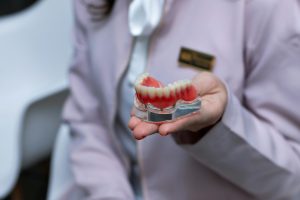
Dentures Costs Explained
Learn about the average dentures cost in Glendale, AZ, and discover how to budget effectively for your new…
Read Article
Denture Relining Explained
Learn why denture relining is essential for comfort and fit in Glendale, AZ, and how this simple process…
Read Article