
Glendale, Arizona
TMJ Treatment in Glendale, AZ
Services provided by an Arizona licensed general dentist.
Jaw pain, clicking, headaches, limited opening, and earaches are common signs of temporomandibular disorder. At SmileScience Dental Spa, we start with the least invasive, most reversible options -- and most patients never need anything more.
Understanding the Condition
What Is TMJ / TMD?
The temporomandibular joint (TMJ) is the hinge connecting your lower jaw to the temporal bones of your skull, located just in front of each ear. It is a bilateral sliding hinge joint -- one of the most complex joints in the human body. It allows you to open, close, move side to side, and protrude your jaw for all the functions of daily life: speaking, eating, yawning, and laughing.
Inside each joint, a small disc of fibrocartilage cushions the surfaces and allows smooth movement. Surrounding the joint is a capsule of ligaments, and the entire system is driven by several large muscle groups -- most notably the masseter, pterygoid, and temporalis muscles.
Temporomandibular disorder (TMD) is a broad term for any condition disrupting normal function of this joint, its disc, or the muscles controlling it. The American Dental Association estimates it affects 10 million Americans. Women are affected at two to three times the rate of men, particularly during reproductive years.
Key Distinction
TMJ vs. TMD
"TMJ" technically refers to the joint itself -- you have one on each side. "TMD" (temporomandibular disorder) is the umbrella term for conditions affecting the joint. Colloquially, patients and clinicians often use "TMJ" to mean the disorder. Both terms refer to the same group of conditions in everyday usage.
Because TMD symptoms overlap heavily with earaches, sinus headaches, and neck problems, it is frequently misdiagnosed -- sometimes for years. If you've been treated repeatedly for ear or sinus complaints that keep returning, TMD is worth evaluating.
Joint Anatomy
The Jaw Joint -- What Can Go Wrong
Understanding the joint structure clarifies why so many different problems produce the same symptoms.
Root Causes
What Causes TMJ Disorder?
TMD is rarely caused by a single factor. Most cases involve a combination of structural, behavioral, and psychological contributors.
Bruxism (Grinding and Clenching)
The leading cause of muscle-driven TMD. Nighttime bruxism applies three to five times normal chewing force to the joint and teeth. Stress and sleep disorders significantly increase bruxism frequency.
Malocclusion (Bite Misalignment)
When the upper and lower teeth do not meet evenly, the joint absorbs asymmetric loading with every chew. Over time this strains the disc, capsule, and supporting muscles on one or both sides.
Trauma and Injury
Direct impact to the jaw (sports, falls, motor vehicle accidents) or whiplash injury can displace the articular disc, stretch the joint capsule, or fracture the condyle. TMD symptoms may develop immediately or months after the event.
Arthritis
Both osteoarthritis and rheumatoid arthritis can affect the TMJ. Osteoarthritis involves gradual cartilage breakdown with age or overload. Rheumatoid arthritis is an inflammatory autoimmune condition requiring coordinated medical and dental management.
Disc Displacement
The articular disc can shift forward (anterior disc displacement) with or without reduction. Clicking occurs when the condyle snaps over the disc during opening. Without reduction, the disc blocks movement and causes acute locking.
Chronic Stress and Muscle Habits
Daytime parafunctional habits -- teeth clenching, jaw bracing, or pressing the tongue against the teeth -- are driven by psychological stress and anxiety. Many patients are unaware they engage in these habits.
Recognizing TMD
Symptoms of TMJ Disorder
The symptom range of TMD is broader than most patients expect. Because the jaw joint and its muscles are interconnected with the ear, temple, and cervical spine, pain frequently radiates well beyond the jaw itself.
Joint Symptoms
- --Clicking, popping, or grating sounds during jaw movement
- --Limited mouth opening (less than 35 mm is clinically reduced)
- --Locking -- jaw stuck open or closed
- --Jaw deviating to one side when opening
- --Pain directly over the joint on palpation
Referred Symptoms
- --Headaches -- temporal, frontal, or suboccipital
- --Earache or sensation of ear fullness without infection
- --Tinnitus (ringing in the ears)
- --Neck and upper shoulder tightness or pain
- --Facial muscle fatigue, especially after eating
How We Evaluate
Diagnosing Your TMJ Condition
Accurate diagnosis is the foundation of effective treatment. A clinical examination in combination with appropriate imaging guides every decision.
We ask about onset, location, quality, and duration of pain; factors that worsen or improve it; sleep quality; stress levels; prior treatments; and any relevant medical history (arthritis, prior jaw trauma, sleep disorders).
We palpate the TMJ, masseter, temporalis, and pterygoid muscles bilaterally to identify pain, trigger points, and asymmetries. We measure maximum interincisal opening and record lateral excursion and protrusive range, noting any deviation or deflection.
Bite registration and wear pattern analysis reveal how load is distributed across the teeth. Premature contacts, worn facets, and fractured restorations indicate where excessive force is occurring and at what magnitude.
Standard periapical and panoramic radiographs allow evaluation of the bony joint structures, condylar shape, and any gross pathology. They are typically the first imaging step when structural changes are suspected.
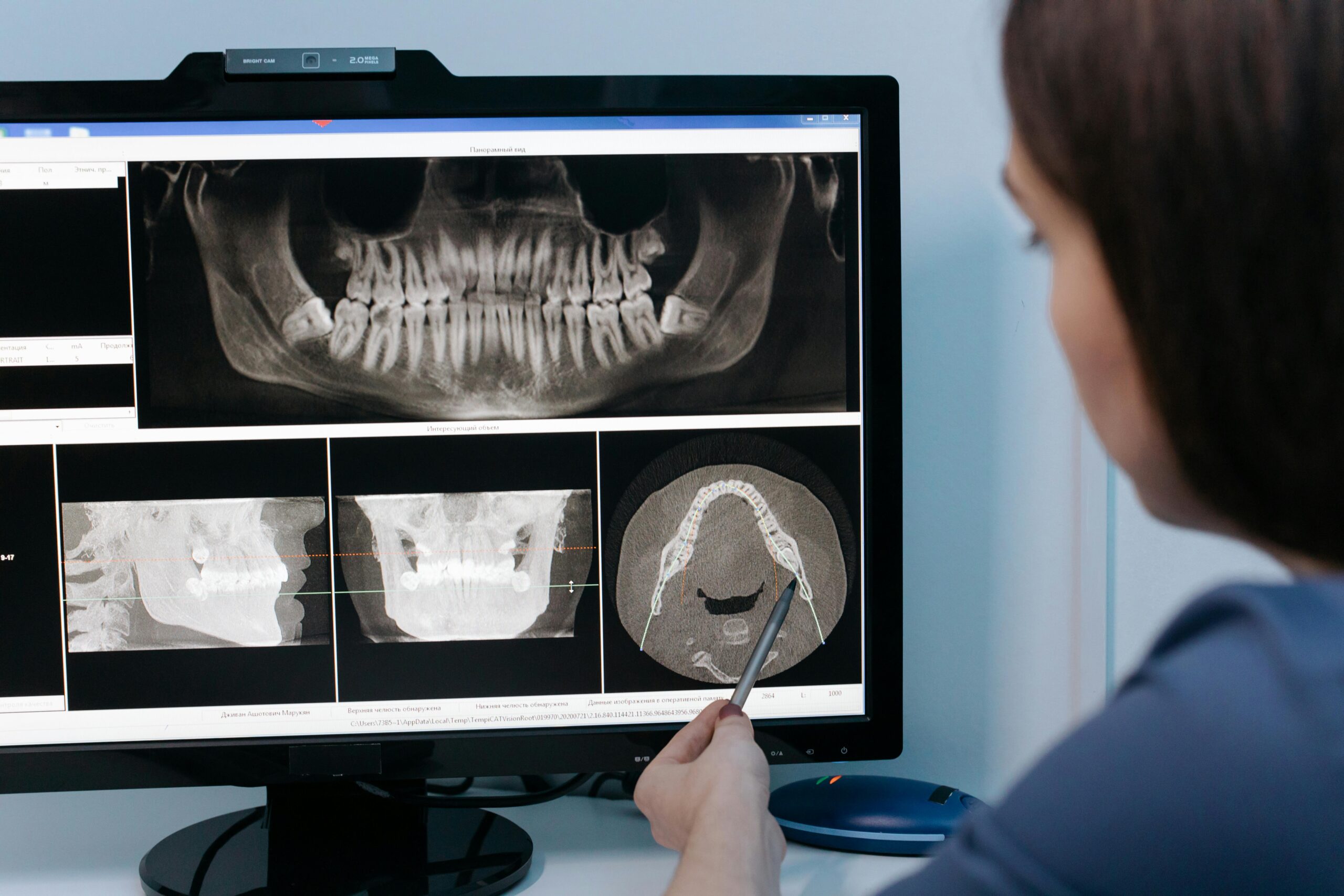
Cone beam CT provides three-dimensional visualization of the condyle, articular eminence, and joint space. We use CBCT when X-rays suggest bony changes, when symptoms are severe or refractory, or when planning more involved treatment. CBCT does not visualize soft tissue (disc position) -- MRI referral is arranged when disc pathology needs confirmation.
First-Line Care
Conservative Treatment -- Where We Always Begin
The guiding principle in TMD management is to start with reversible, non-invasive interventions. The majority of patients achieve lasting relief at this level.
Custom Nightguard / Occlusal Splint
The most commonly prescribed first-line treatment for bruxism-related TMD. A nightguard (also called an occlusal splint or stabilization appliance) is fabricated from precision impressions of your teeth and worn during sleep. It creates a flat, stable biting surface that:
- --Prevents the teeth from fully engaging during grinding, reducing clenching force transmitted to the joint
- --Repositions the condyle in a slightly more centered, comfortable position
- --Reduces muscle activity by removing posterior tooth contacts that trigger grinding reflexes
- --Protects tooth enamel and existing restorations from wear
Most patients notice reduced morning jaw soreness and headaches within 2 to 4 weeks of consistent nightguard use. Maximum benefit typically develops over 2 to 3 months.
Physical Therapy and Jaw Exercises
Structured jaw stretching, strengthening, and mobility exercises directly address the muscular component of TMD. A physical therapy protocol typically includes: passive assisted opening stretches, lateral excursion exercises, postural correction training, and manual soft tissue therapy for the masticatory muscles. Referral to a licensed physical therapist with cervical spine expertise is often coordinated when neck contributions are identified.
NSAIDs and Short-Course Anti-Inflammatories
Non-steroidal anti-inflammatory drugs (ibuprofen, naproxen) reduce joint and muscle inflammation during acute flare-ups. We may recommend a short structured course (10 to 14 days) to break the pain-tension cycle while other therapies take hold. We coordinate with your physician for prescription-strength options when over-the-counter dosing is insufficient.
Lifestyle Modification and Self-Care
Behavioral strategies are an essential complement to appliance and physical therapy. These include: soft diet during flare-ups to reduce joint loading; moist heat application to relax muscles; awareness training to break daytime clenching habits; stress reduction practices; and sleep hygiene improvements (given the strong link between bruxism and sleep quality).
Therapeutic Botox -- Masseter and Temporalis Injections
When a nightguard alone does not sufficiently reduce muscle-driven jaw pain, Dr. Turke offers therapeutic botulinum toxin injections. Small doses are injected directly into the masseter and temporalis muscles. This reduces the force these muscles generate during bruxism events without affecting normal chewing or speech.
Results are typically noticeable within 7 to 14 days and last 4 to 6 months. Patients with masseter hypertrophy (enlarged jaw muscles from chronic clenching) see particularly dramatic relief. Repeated treatments over 12 to 18 months can produce lasting reductions in muscle bulk. This is a therapeutic medical application of Botox -- distinct from cosmetic use and covered by some medical insurance plans.
Protecting Your Investment
Nightguard Design and Care
Types of Nightguards
The clinical standard for TMD. Covers all upper or lower teeth. Hard material allows precise equilibration and provides stable occlusal contacts. Most durable option -- typically lasts 3 to 5 years.
More comfortable to wear but can stimulate clenching in some patients. Generally preferred for mild cases or when hard acrylic is not tolerated. Shorter lifespan -- typically 1 to 2 years.
Hard outer surface with a soft inner layer. Combines comfort of the soft guard with the durability of the hard acrylic. A useful middle option for moderate bruxism.
Daily Nightguard Care
- --Rinse under cool water immediately after removing each morning
- --Brush gently with a soft toothbrush and mild soap -- never toothpaste (abrasive)
- --Soak weekly in a denture or retainer cleaning tablet solution
- --Allow to dry completely before storing in the provided vented case
- --Keep away from heat -- hot water warps acrylic permanently
- --Bring to every dental appointment for inspection and re-equilibration
When Conservative Care Is Not Enough
Escalation -- More Involved Options
The large majority of TMD patients never require these steps. When conservative care over 3 to 6 months does not resolve symptoms, additional options are available.
Occlusal Adjustment
Selective reshaping of specific tooth surfaces to eliminate premature contacts and create a more balanced bite. Performed only when bite analysis confirms specific contacts driving TMD symptoms. This is an irreversible procedure -- we approach it conservatively and only when clearly indicated.
Orthodontic Correction
When malocclusion is a confirmed contributing driver and cannot be adequately managed with a splint, orthodontic treatment (Invisalign or braces) to correct the underlying bite may be recommended in coordination with an orthodontist.
Advanced Imaging -- CBCT and MRI
If symptoms are severe, progressive, or non-responsive to conservative care, CBCT imaging evaluates bony joint changes. MRI (ordered through referral) visualizes disc position and soft tissue pathology. These findings guide decisions about whether referral to a specialist is appropriate.
Corticosteroid Joint Injection
Corticosteroid injections directly into the joint space reduce severe inflammatory flare-ups and can provide significant temporary relief to allow healing. Performed by a specialist when indicated -- we coordinate the referral.
Surgical Referral
Arthroscopy, arthroplasty, or joint replacement are considered only when all conservative and non-surgical approaches have failed and structural pathology is confirmed. The vast majority of TMD patients never reach this point. When surgical consultation is appropriate, we provide referral to an experienced specialist.
What Our Patients Say
4.9 (437 reviews)
I recently had the pleasure of visiting Smile Science Dental Spa, and I couldn't be more impressed with the level of care and service provided by the entire team. Dr. Dawson and Dr. Turke are both incredibly skilled and made me feel completely at ease throughout my procedures. Their professionalism, combined with their gentle approach, made me feel comfortable and well-informed every step of the way. I was especially impressed that I was able to get a same-day crown(apparently their first ever!), which exceeded my expectations. I couldn’t believe how quick and seamless the process was. It really saved me time and made the experience even more convenient. Cindiray and Angeles, the dental assistants, were equally wonderful. They were not only friendly and attentive but also thorough in explaining everything and made sure I was relaxed during each phase of my visit. Lastly, a big thank you to Litzy at the front desk, who greeted me with a smile and helped with scheduling and any questions I had. She made the entire check-in process a breeze. From start to finish, my experience at Smile Science Dental Spa was exceptional. I'll be returning for sure. I highly, highly, highly recommend them for anyone looking for high-quality dental care.
View Full Review on GoogleDusty

Honestly I’ve never been so happy to go to the dentist. I came in (late due to Lyft) and was still taken care of and treated with care. Even without insurance (kicking in within the next month) prices for an extraction on my infected tooth were more than reasonable. I was able to get more than expected done in the same visit. Dr. Dawson and his team made me feel so comfortable and taken care of. Won’t go anywhere else.
View Full Review on GoogleCherish B

I recently started as a patient after leaving our long-time family Dentist and couldn’t be happier! Marcela is AMAZING and a FANTASTIC hygienist!!!! 😃 Dr Dawson is great too! Every time I visit, they make me feel like family.
View Full Review on GoogleTJ Winzeler

Myself and my family had previously gone to Dr. Turk at another dental office that he worked at. He had relocated and we did not know where he had gone to until this week. Today I got in with Dr. Turk and he took the time to look at my x-rays carefully . I was having pain from a tooth and some other issues. The previous Dentist I went to that I saw just a few days earlier, he did not find any issues with my tooth which I had pain in. Dr. Turk identified infection and referred me to an endodontist. He is very gentle as a wonderful disposition and my self and my family are thrilled to be able to get back with him. The office is lovely, relaxing music, heat and massage chair.I have always been very nervous and some anxiety going to dentist as I have had bad reactions with the anesthesia. I am confident that Dr. Kirk will help me get through my next appointment just fine. “The staff are very kind and attentive. I am looking forward as I have quite a bit of work to be done, and I know I’m in good hands with Dr. Turk and his staff. Five stars!⭐️ Sherry
View Full Review on GoogleSherry Redmond

I recently moved to Arizona and had an issue with a tooth repair from 15 years back. Not knowing anyone here in my new home, I searched dentists close to me. I chose Smile Science much like pinning the tail on the donkey and my selection couldn't have been better! What a terrific staff! Dr. Turke was concerned the tooth would need to be extracted, but said he wanted to take a shot at saving it..and that's just what he did! After setting a temporary crown, I was on my way with an appointment to install the permanent crown in the following two weeks. That evening I received a call I've never received from a dentist. Dr. Turke had taken the time to follow up with me to make sure I wasn't in any discomfort..I was completely caught off guard by this kind of attention to detail and caring for my well being. The permanent crown is now in place, it fits and feels fantastic, the job and treatment are first class! Thank you, Dr. Turke and staff for taking in this stray and giving me a home dentist! I'd like to say that I'm just good at selecting blindly, but the truth is I am very lucky..and I'll take lucky over being good any day of the week! Thank you, again and Happiest of New Year's in 2026, Science Smile!!
View Full Review on GoogleEddy

TMJ Treatment FAQ
Not necessarily. Clicking without pain or restricted movement is extremely common and often does not warrant treatment -- only monitoring. If clicking is accompanied by pain, limited opening, locking, or morning jaw soreness, that combination warrants a full TMD evaluation.
Yes. The TMJ sits directly in front of the ear canal and shares overlapping nerve pathways. Inflammation, disc displacement, or muscle tension can cause referred pain that is indistinguishable from an earache. If your ear pain clears with antibiotics but recurs repeatedly, or if ENT exams show nothing, TMD is a strong consideration.
Most patients notice reduced morning jaw soreness and headaches within 2 to 4 weeks of consistent use. Full benefit typically develops over 2 to 3 months as the muscles gradually de-condition from chronic tension patterns. If you see no improvement after 6 weeks, we re-evaluate and may adjust the appliance design or add a complementary treatment.
Coverage varies by plan. Many dental plans cover nightguards and splints. Therapeutic Botox for jaw muscle pain may be covered by medical insurance as a pain management procedure. We provide a detailed treatment plan and help you understand your specific benefits before you commit to any treatment.
Yes, and frequently so. TMD-related headaches are typically tension-type and located at the temples, but they can be severe, unilateral, and accompanied by light sensitivity -- a profile consistent with migraine. If your headaches are worst in the morning, correlate with jaw soreness, or improve significantly on days you wear your nightguard, TMD is likely contributing.
For most patients, TMD is a manageable chronic condition rather than a permanent one. Many patients remain symptom-free indefinitely after conservative treatment, especially if they maintain nightguard use during high-stress periods. Patients whose TMD is driven primarily by stress-related bruxism may experience periodic flare-ups, particularly at times of elevated stress. Maintenance care -- not constant treatment -- is the typical long-term approach.
Stress is a major contributing factor but rarely the sole cause. Psychological stress significantly increases bruxism frequency -- the primary mechanical driver of TMD. Stress reduction, mindfulness practices, and cognitive behavioral therapy have demonstrated measurable benefits in clinical trials for TMD. We incorporate behavioral guidance alongside dental treatment.
A dentist is the appropriate first contact for jaw pain that involves the teeth, bite, clicking, or jaw joint itself. A physician should be seen first if the jaw pain is accompanied by fever, swelling, difficulty swallowing, or any symptoms suggesting a spreading dental infection. If jaw pain accompanies chest pain or left arm pain, call 911 immediately.
4.9 (437 reviews)
I recently had the pleasure of visiting Smile Science Dental Spa, and I couldn't be more impressed with the level of care and service provided by the entire team. Dr. Dawson and Dr. Turke are both incredibly skilled and made me feel completely at ease throughout my procedures. Their professionalism, combined with their gentle approach, made me feel comfortable and well-informed every step of the way. I was especially impressed that I was able to get a same-day crown(apparently their first ever!), which exceeded my expectations. I couldn’t believe how quick and seamless the process was. It really saved me time and made the experience even more convenient. Cindiray and Angeles, the dental assistants, were equally wonderful. They were not only friendly and attentive but also thorough in explaining everything and made sure I was relaxed during each phase of my visit. Lastly, a big thank you to Litzy at the front desk, who greeted me with a smile and helped with scheduling and any questions I had. She made the entire check-in process a breeze. From start to finish, my experience at Smile Science Dental Spa was exceptional. I'll be returning for sure. I highly, highly, highly recommend them for anyone looking for high-quality dental care.
View Full Review on GoogleDusty
Honestly I’ve never been so happy to go to the dentist. I came in (late due to Lyft) and was still taken care of and treated with care. Even without insurance (kicking in within the next month) prices for an extraction on my infected tooth were more than reasonable. I was able to get more than expected done in the same visit. Dr. Dawson and his team made me feel so comfortable and taken care of. Won’t go anywhere else.
View Full Review on GoogleCherish B
I recently started as a patient after leaving our long-time family Dentist and couldn’t be happier! Marcela is AMAZING and a FANTASTIC hygienist!!!! 😃 Dr Dawson is great too! Every time I visit, they make me feel like family.
View Full Review on GoogleTJ Winzeler
Myself and my family had previously gone to Dr. Turk at another dental office that he worked at. He had relocated and we did not know where he had gone to until this week. Today I got in with Dr. Turk and he took the time to look at my x-rays carefully . I was having pain from a tooth and some other issues. The previous Dentist I went to that I saw just a few days earlier, he did not find any issues with my tooth which I had pain in. Dr. Turk identified infection and referred me to an endodontist. He is very gentle as a wonderful disposition and my self and my family are thrilled to be able to get back with him. The office is lovely, relaxing music, heat and massage chair.I have always been very nervous and some anxiety going to dentist as I have had bad reactions with the anesthesia. I am confident that Dr. Kirk will help me get through my next appointment just fine. “The staff are very kind and attentive. I am looking forward as I have quite a bit of work to be done, and I know I’m in good hands with Dr. Turk and his staff. Five stars!⭐️ Sherry
View Full Review on GoogleSherry Redmond
I recently moved to Arizona and had an issue with a tooth repair from 15 years back. Not knowing anyone here in my new home, I searched dentists close to me. I chose Smile Science much like pinning the tail on the donkey and my selection couldn't have been better! What a terrific staff! Dr. Turke was concerned the tooth would need to be extracted, but said he wanted to take a shot at saving it..and that's just what he did! After setting a temporary crown, I was on my way with an appointment to install the permanent crown in the following two weeks. That evening I received a call I've never received from a dentist. Dr. Turke had taken the time to follow up with me to make sure I wasn't in any discomfort..I was completely caught off guard by this kind of attention to detail and caring for my well being. The permanent crown is now in place, it fits and feels fantastic, the job and treatment are first class! Thank you, Dr. Turke and staff for taking in this stray and giving me a home dentist! I'd like to say that I'm just good at selecting blindly, but the truth is I am very lucky..and I'll take lucky over being good any day of the week! Thank you, again and Happiest of New Year's in 2026, Science Smile!!
View Full Review on GoogleEddy
Jaw Pain You Have Lived With Too Long
TMD is treatable. SmileScience Dental Spa offers custom nightguards, therapeutic Botox for jaw muscle pain, CBCT imaging, and a conservative step-by-step care approach in Glendale, AZ. Call or book online to start.