
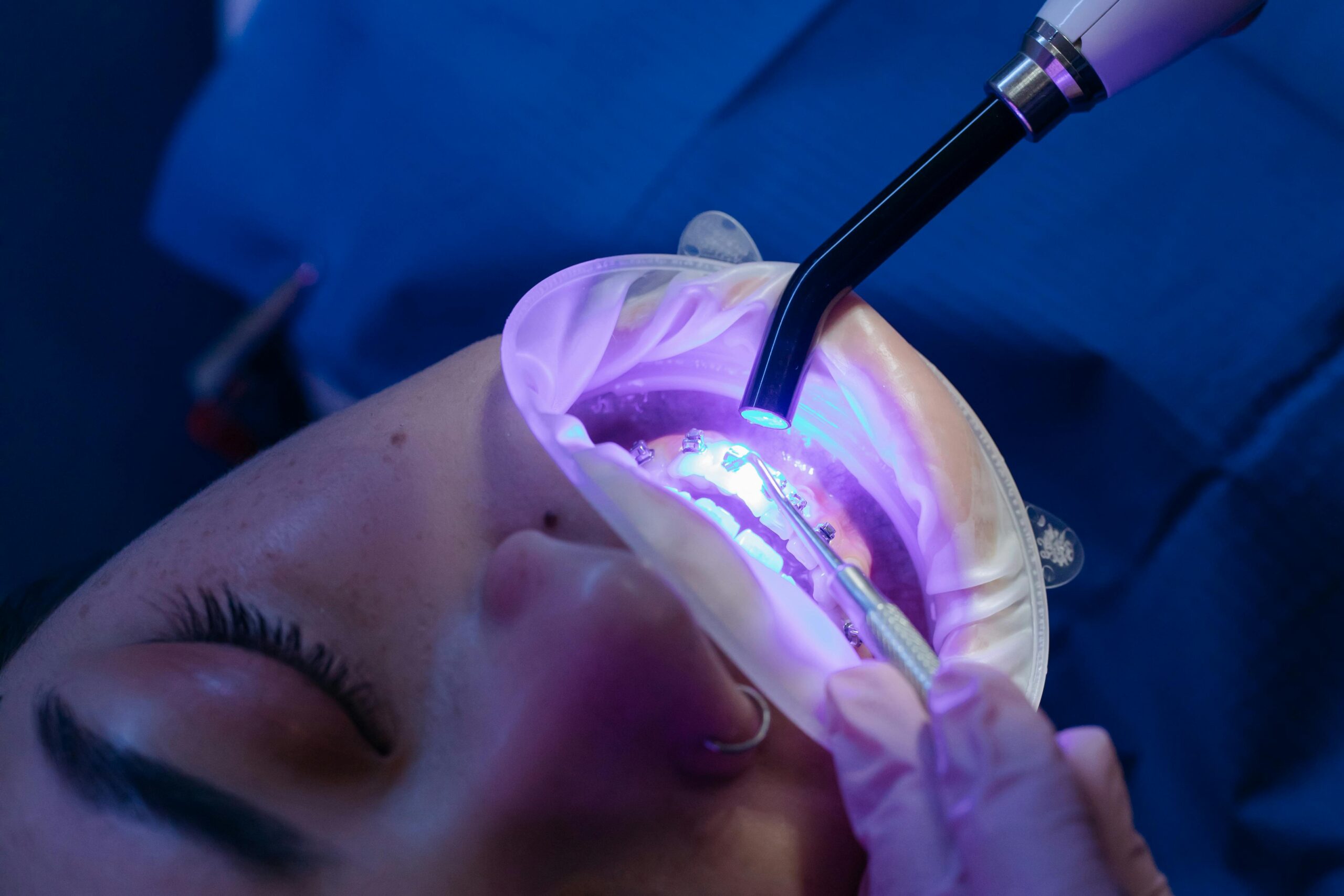
Glendale, Arizona
Invisalign vs. Braces in Glendale, AZ -- Which Is Right for You?
Services provided by an Arizona licensed general dentist.
SmileScience offers both Invisalign clear aligners and traditional braces. We don't push patients toward either option -- our recommendation is based entirely on what will give you the best clinical result for your specific case.
Invisalign at SmileScience
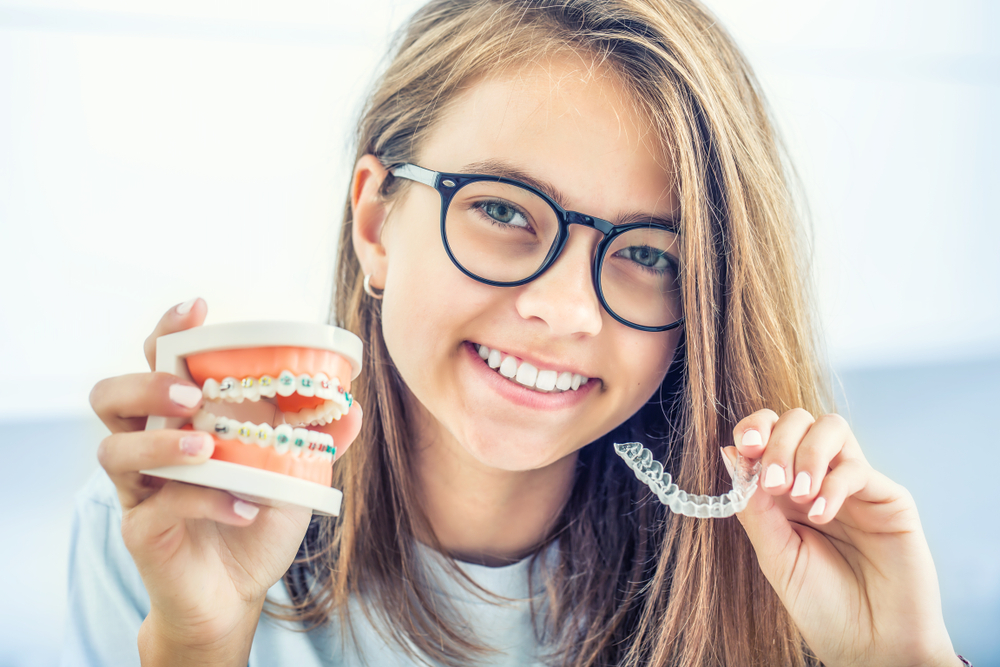
The Real Difference Between Invisalign and Braces
The honest answer is that for most patients, both options work. Teeth don't know whether they're being moved by a clear plastic aligner or a metal bracket -- they respond to sustained, controlled force either way. The differences come down to lifestyle, case complexity, appearance during treatment, and how well you'll stick to the plan.
This page breaks down every meaningful difference so you can walk into your consultation with an informed perspective. Our doctors will then give you their honest clinical recommendation based on your specific teeth and goals.
Quick Comparison at a Glance
| Factor | Invisalign | Traditional Braces |
|---|---|---|
| Appearance | Nearly invisible | Visible metal brackets |
| Removable | Yes | No (fixed) |
| Diet restrictions | None | Avoid hard & sticky foods |
| Oral hygiene | Normal brushing & flossing | Extra care around brackets |
| Typical timeline | 12-18 months | 18-24 months |
| Complex cases | Good for most; limits on severe rotations | Better for highly complex cases |
| Compliance required | 20-22 hrs/day (patient-driven) | Automatic (always on) |
| Cost at SmileScience | $2,500 / $4,499 / $5,999 | Often within $500 of Invisalign |
Effectiveness by Case Complexity
Not every orthodontic case is the same. Here is how the two options compare based on the level of correction needed.
Mild Crowding or Spacing
Invisalign is typically the preferred choice for mild corrections -- especially post-braces relapse. Treatment may be completed in as little as 6 to 9 months and often costs less than a comprehensive case.
Verdict: Invisalign is usually ideal.
Moderate Crowding, Bite Issues
Both options are effective. Invisalign handles most moderate cases well with modern aligner technology. Braces may be slightly faster for certain bite correction patterns. Your doctor will review which fits your specific anatomy.
Verdict: Either can work -- consultation determines best fit.
Severe Rotations, Significant Bite Shifts
Traditional braces have an advantage for cases involving severe tooth rotations, significant vertical movements, or skeletal bite corrections that require additional appliances. In these situations we'll discuss the honest tradeoffs with you.
Verdict: Braces may produce a more predictable outcome.
The Factors That Matter Most
Treatment Timeline
Invisalign cases typically run 12 to 18 months for comprehensive treatment. Braces cases typically run 18 to 24 months. The difference reflects both the average case mix and some mechanical differences in how force is applied -- not that braces are more thorough.
For minor corrections, Invisalign's timeline advantage is even more pronounced. A post-orthodontic touch-up with clear aligners can sometimes be done in as few as 3 to 6 months.
Cost Comparison
Many patients assume braces are always significantly cheaper. At SmileScience, the two options are typically within $500 of each other for comparable cases. Both are influenced by the same factors: total treatment duration, number of appointments, and case complexity.
Both options are covered by orthodontic insurance benefits where applicable, and both can be financed through CareCredit, Cherry, Sunbit, or Proceed Finance. See our Invisalign pricing page for a detailed breakdown.
Comfort During Treatment
Invisalign aligners are made from smooth, flexible plastic. There are no brackets that can poke the inside of your cheeks and no wires that can snap and scrape your gum tissue. Most patients report that discomfort is limited to mild pressure for a day or two when switching to a new aligner set.
Traditional braces involve more frequent adjustments, and many patients experience several days of soreness after each visit. Orthodontic wax helps with bracket irritation but is a recurring inconvenience throughout multi-year treatment.
Appearance During Treatment
Invisalign aligners are nearly transparent. In most social and professional settings, people will not notice you are undergoing orthodontic treatment. Some patients also choose tooth-colored ceramic brackets with braces as a middle-ground, though these are more visible than aligners and can still stain over time.
For adults in professional roles, patient-facing careers, or anyone who simply values discretion, this factor alone often drives the decision toward Invisalign.
The Compliance Factor
This is the most honest part of any Invisalign vs. braces conversation: Invisalign only works if you wear your aligners. The clinical recommendation is 20 to 22 hours per day -- meaning they come out only to eat, drink anything except water, and brush your teeth.
Patients who are disciplined about wearing time consistently get excellent results. Patients who frequently remove aligners for hours at a time will find treatment extended or results compromised. Braces eliminate this variable entirely because they are fixed and always working. This is an important consideration for younger teens or patients who are honest with themselves about compliance habits.
Oral Hygiene
Because aligners are removable, oral hygiene with Invisalign is essentially the same as without orthodontic treatment. You remove the aligners, brush, floss, and replace them. There are no brackets or wires to navigate around, no special floss threaders, and no interproximal brushes required.
Braces require extra effort to keep clean. Food tends to get trapped around brackets, and plaque buildup in those areas can lead to decalcification -- white spots on the enamel surface -- if brushing is not thorough. This is not a reason to avoid braces, but it is a real daily difference patients should anticipate.
Who Tends to Choose Each Option
Patients Who Choose Invisalign
- •Working adults and professionals
- •Patients in patient-facing or public roles
- •Responsible teens with strong compliance habits
- •Anyone returning after previous braces treatment
- •Patients with mild-to-moderate cases
Patients Who May Be Better With Braces
- •Patients with highly complex rotations or bite shifts
- •Patients who are honest they won't maintain 22 hours/day
- •Younger teens needing more structure in treatment
- •Cases where braces are the clinical best choice
Our Approach: No Sales Pressure, No Preferred Option
SmileScience offers both Invisalign and traditional braces because the right choice genuinely depends on the individual. We are not commission-based and we do not have an incentive to push you toward one option over the other.
At your consultation, we take a digital scan, review your tooth positions and bite, and give you an honest recommendation. If we think Invisalign is the better clinical fit, we'll say so. If we think braces will give you a more predictable result for your specific situation, we'll say that too -- and explain why.
You leave with a clear picture of both options, the clinical reasoning behind any recommendation, and a treatment plan you feel confident about.
Schedule Your Free ConsultationContinue Your Research
Learn more about Invisalign at SmileScience.
Invisalign Overview
How Invisalign works, who is a candidate, and what to expect from the process at SmileScience.
Invisalign Pricing & Financing
Detailed cost breakdown, insurance coverage, and flexible monthly payment options.
Invisalign for Adults
Discreet treatment for professionals, relapse cases, and cosmetic combinations.
Invisalign for Teens
Teen-specific features including compliance indicators and free replacement aligners.
Medical Review & Evidence
Invisalign clear aligner therapy is supported by over 20 years of published clinical research and more than 15 million treated patients worldwide.
- Invisalign achieves equivalent orthodontic outcomes to fixed appliances for mild-to-moderate crowding and spacing cases, per systematic review evidence.[1]
- Patient-reported quality of life during Invisalign treatment is significantly higher than during fixed-appliance treatment, primarily due to comfort and aesthetics.[2]
- iTero digital scanning eliminates traditional impression material and provides greater dimensional accuracy than alginate impressions for orthodontic models.[3]
- ClinCheck treatment simulation enables clinicians to visualize and adjust tooth movement staging prior to aligner fabrication, improving treatment predictability.[4]
- Ke Y, et al. A comparison of treatment effectiveness between clear aligner and fixed appliance therapies. BMC Oral Health. 2019;19(1):24.
- Pacheco-Pereira C, et al. Factors associated with patient and parent satisfaction after orthodontic treatment. Am J Orthod Dentofacial Orthop. 2015;148(4):652–659.
- Wiranto MG, et al. Validity, reliability, and reproducibility of the iTero intraoral scanner to measure tooth dimensions. Am J Orthod Dentofacial Orthop. 2013;143(2):194–199.
- Kravitz ND, et al. How well does Invisalign work? A prospective clinical study evaluating the efficacy of tooth movement. Am J Orthod Dentofacial Orthop. 2009;135(1):27–35.
This page is reviewed periodically for clinical accuracy. Individual treatment outcomes vary. Consult your SmileScience provider for a personalized assessment.
4.9 (437 reviews)
I recently had the pleasure of visiting Smile Science Dental Spa, and I couldn't be more impressed with the level of care and service provided by the entire team. Dr. Dawson and Dr. Turke are both incredibly skilled and made me feel completely at ease throughout my procedures. Their professionalism, combined with their gentle approach, made me feel comfortable and well-informed every step of the way. I was especially impressed that I was able to get a same-day crown(apparently their first ever!), which exceeded my expectations. I couldn’t believe how quick and seamless the process was. It really saved me time and made the experience even more convenient. Cindiray and Angeles, the dental assistants, were equally wonderful. They were not only friendly and attentive but also thorough in explaining everything and made sure I was relaxed during each phase of my visit. Lastly, a big thank you to Litzy at the front desk, who greeted me with a smile and helped with scheduling and any questions I had. She made the entire check-in process a breeze. From start to finish, my experience at Smile Science Dental Spa was exceptional. I'll be returning for sure. I highly, highly, highly recommend them for anyone looking for high-quality dental care.
View Full Review on GoogleDusty

Honestly I’ve never been so happy to go to the dentist. I came in (late due to Lyft) and was still taken care of and treated with care. Even without insurance (kicking in within the next month) prices for an extraction on my infected tooth were more than reasonable. I was able to get more than expected done in the same visit. Dr. Dawson and his team made me feel so comfortable and taken care of. Won’t go anywhere else.
View Full Review on GoogleCherish B

I recently started as a patient after leaving our long-time family Dentist and couldn’t be happier! Marcela is AMAZING and a FANTASTIC hygienist!!!! 😃 Dr Dawson is great too! Every time I visit, they make me feel like family.
View Full Review on GoogleTJ Winzeler

Myself and my family had previously gone to Dr. Turk at another dental office that he worked at. He had relocated and we did not know where he had gone to until this week. Today I got in with Dr. Turk and he took the time to look at my x-rays carefully . I was having pain from a tooth and some other issues. The previous Dentist I went to that I saw just a few days earlier, he did not find any issues with my tooth which I had pain in. Dr. Turk identified infection and referred me to an endodontist. He is very gentle as a wonderful disposition and my self and my family are thrilled to be able to get back with him. The office is lovely, relaxing music, heat and massage chair.I have always been very nervous and some anxiety going to dentist as I have had bad reactions with the anesthesia. I am confident that Dr. Kirk will help me get through my next appointment just fine. “The staff are very kind and attentive. I am looking forward as I have quite a bit of work to be done, and I know I’m in good hands with Dr. Turk and his staff. Five stars!⭐️ Sherry
View Full Review on GoogleSherry Redmond

I recently moved to Arizona and had an issue with a tooth repair from 15 years back. Not knowing anyone here in my new home, I searched dentists close to me. I chose Smile Science much like pinning the tail on the donkey and my selection couldn't have been better! What a terrific staff! Dr. Turke was concerned the tooth would need to be extracted, but said he wanted to take a shot at saving it..and that's just what he did! After setting a temporary crown, I was on my way with an appointment to install the permanent crown in the following two weeks. That evening I received a call I've never received from a dentist. Dr. Turke had taken the time to follow up with me to make sure I wasn't in any discomfort..I was completely caught off guard by this kind of attention to detail and caring for my well being. The permanent crown is now in place, it fits and feels fantastic, the job and treatment are first class! Thank you, Dr. Turke and staff for taking in this stray and giving me a home dentist! I'd like to say that I'm just good at selecting blindly, but the truth is I am very lucky..and I'll take lucky over being good any day of the week! Thank you, again and Happiest of New Year's in 2026, Science Smile!!
View Full Review on GoogleEddy

Frequently Asked Questions
For the majority of patients -- including moderate crowding, spacing, overbite, underbite, and crossbite cases -- Invisalign produces results that are clinically equivalent to braces. The key variables are case complexity and patient compliance. For very complex cases, braces may offer more predictable control over specific tooth movements.
At SmileScience, Invisalign and traditional braces are typically within $500 of each other for comparable cases. Some practices price Invisalign significantly higher, but we calibrate fees based on the actual complexity of your treatment, not the appliance type. Both options are covered by orthodontic insurance benefits and are available on financing.
Adults make up the majority of Invisalign patients nationwide. The clear aligner format is particularly well-suited to adults who want to straighten their teeth without the visibility of metal brackets during the process. There is no upper age limit for Invisalign, provided the teeth and supporting bone are healthy.
That's exactly what the consultation is for. We take a digital scan, assess your case, and discuss both options honestly with you. You'll have all the information you need before making any decision. There is no obligation and no pressure to commit during your first visit.
Patients who succeed with Invisalign tend to be consistent about their wearing routine from the start. The easiest approach is to only remove aligners when eating or brushing -- which typically accounts for an hour or two per day, keeping total wear time well above 22 hours. Building the habit early makes it second nature. If you're genuinely concerned about compliance, that's a good thing to discuss openly so we can factor it into your recommendation.
In some cases, yes -- but it depends on where you are in treatment and what tooth movements remain. Switching mid-treatment requires a new digital scan and a new ClinCheck plan. If you started braces elsewhere and are interested in finishing with clear aligners, bring your records to a consultation and we can assess whether it's a good option for your remaining tooth movement.
Yes. Both Dr. Turke and Dr. Dawson are certified Invisalign providers and are trained in fixed appliance orthodontics. Dr. Turke leads the majority of orthodontic case planning at SmileScience, with particular expertise in digital treatment planning via ClinCheck. Neither doctor steers patients toward one option -- the recommendation is based entirely on what will produce the best clinical outcome for your specific case.
We assess case complexity thoroughly during your free consultation using a 3D scan and full diagnostic records before recommending a treatment path. If an unusual finding emerges during treatment, we discuss your options directly -- including whether fixed appliances would be more appropriate. We would rather tell you upfront that braces are the better choice than start an Invisalign case we cannot complete successfully.
4.9 (437 reviews)
I recently had the pleasure of visiting Smile Science Dental Spa, and I couldn't be more impressed with the level of care and service provided by the entire team. Dr. Dawson and Dr. Turke are both incredibly skilled and made me feel completely at ease throughout my procedures. Their professionalism, combined with their gentle approach, made me feel comfortable and well-informed every step of the way. I was especially impressed that I was able to get a same-day crown(apparently their first ever!), which exceeded my expectations. I couldn’t believe how quick and seamless the process was. It really saved me time and made the experience even more convenient. Cindiray and Angeles, the dental assistants, were equally wonderful. They were not only friendly and attentive but also thorough in explaining everything and made sure I was relaxed during each phase of my visit. Lastly, a big thank you to Litzy at the front desk, who greeted me with a smile and helped with scheduling and any questions I had. She made the entire check-in process a breeze. From start to finish, my experience at Smile Science Dental Spa was exceptional. I'll be returning for sure. I highly, highly, highly recommend them for anyone looking for high-quality dental care.
View Full Review on GoogleDusty
Honestly I’ve never been so happy to go to the dentist. I came in (late due to Lyft) and was still taken care of and treated with care. Even without insurance (kicking in within the next month) prices for an extraction on my infected tooth were more than reasonable. I was able to get more than expected done in the same visit. Dr. Dawson and his team made me feel so comfortable and taken care of. Won’t go anywhere else.
View Full Review on GoogleCherish B
I recently started as a patient after leaving our long-time family Dentist and couldn’t be happier! Marcela is AMAZING and a FANTASTIC hygienist!!!! 😃 Dr Dawson is great too! Every time I visit, they make me feel like family.
View Full Review on GoogleTJ Winzeler
Myself and my family had previously gone to Dr. Turk at another dental office that he worked at. He had relocated and we did not know where he had gone to until this week. Today I got in with Dr. Turk and he took the time to look at my x-rays carefully . I was having pain from a tooth and some other issues. The previous Dentist I went to that I saw just a few days earlier, he did not find any issues with my tooth which I had pain in. Dr. Turk identified infection and referred me to an endodontist. He is very gentle as a wonderful disposition and my self and my family are thrilled to be able to get back with him. The office is lovely, relaxing music, heat and massage chair.I have always been very nervous and some anxiety going to dentist as I have had bad reactions with the anesthesia. I am confident that Dr. Kirk will help me get through my next appointment just fine. “The staff are very kind and attentive. I am looking forward as I have quite a bit of work to be done, and I know I’m in good hands with Dr. Turk and his staff. Five stars!⭐️ Sherry
View Full Review on GoogleSherry Redmond
I recently moved to Arizona and had an issue with a tooth repair from 15 years back. Not knowing anyone here in my new home, I searched dentists close to me. I chose Smile Science much like pinning the tail on the donkey and my selection couldn't have been better! What a terrific staff! Dr. Turke was concerned the tooth would need to be extracted, but said he wanted to take a shot at saving it..and that's just what he did! After setting a temporary crown, I was on my way with an appointment to install the permanent crown in the following two weeks. That evening I received a call I've never received from a dentist. Dr. Turke had taken the time to follow up with me to make sure I wasn't in any discomfort..I was completely caught off guard by this kind of attention to detail and caring for my well being. The permanent crown is now in place, it fits and feels fantastic, the job and treatment are first class! Thank you, Dr. Turke and staff for taking in this stray and giving me a home dentist! I'd like to say that I'm just good at selecting blindly, but the truth is I am very lucky..and I'll take lucky over being good any day of the week! Thank you, again and Happiest of New Year's in 2026, Science Smile!!
View Full Review on GoogleEddy
See Which Option Fits Your Smile
Book a free consultation at SmileScience Dental Spa in Glendale, AZ. We'll scan your teeth and walk you through your options -- no pressure, no obligation.