
Glendale, Arizona
Invisalign for Adults in Glendale, AZ
It is never too late for a straighter smile. Dr. Turke and Dr. Dawson offer Invisalign clear aligner treatment for adults at every stage of life -- discreet, removable, and designed to fit around your professional and personal schedule. Most adult cases complete in 12 to 18 months.
Invisalign at SmileScience
The Case for Invisalign
Why Adults Choose Invisalign Over Braces
Metal braces work -- but they come with trade-offs that matter a lot more once you are an adult. Here is why Invisalign is the preferred choice for the majority of adult orthodontic patients at SmileScience.
Virtually Invisible
Clear aligners are nearly undetectable in everyday conversation. In professional settings -- meetings, presentations, client-facing roles -- most people will never know you are straightening your teeth.
No Dietary Restrictions
Remove your aligners and eat whatever you like. No avoiding popcorn, apples, or hard bread. No food trapped in brackets. Just take them out, eat, brush, and put them back in.
Professional Life Compatibility
Important presentation, job interview, or first date? Remove the aligners for a few hours. Adult life has events that matter -- Invisalign accommodates them in a way fixed appliances simply cannot.
Comfort
Smooth BPA-free plastic with no brackets or wires means no metal irritation against cheeks and gums. Most adult Invisalign patients describe comfort as significantly better than their memories of braces.
Easy Oral Hygiene
Because aligners are fully removable, you brush and floss your teeth exactly as you normally would. No interdental brushes, no floss threaders, no navigating around brackets. Good oral hygiene is straightforward throughout treatment.
Preview Your Result First
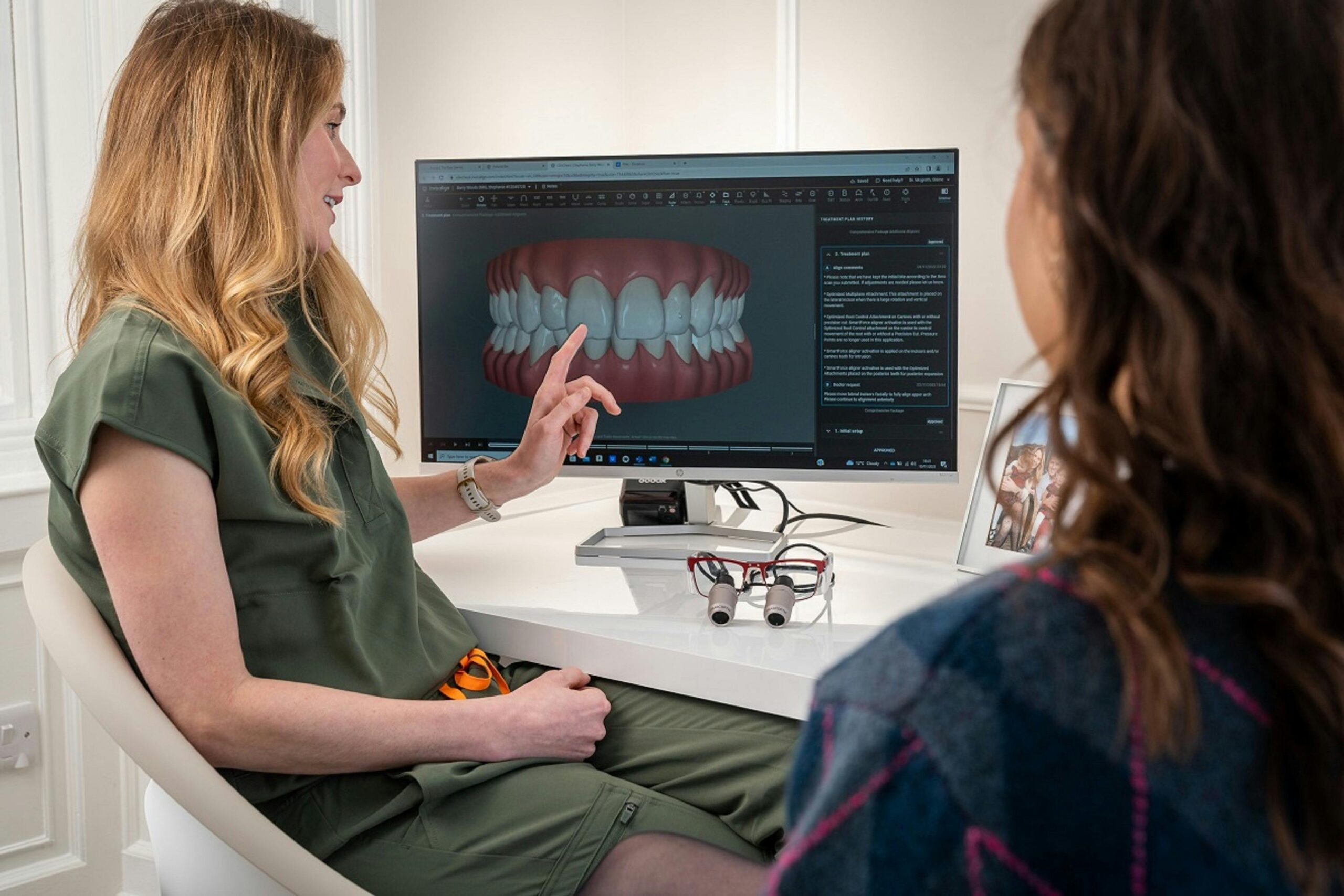
ClinCheck 3D simulation lets you see a projection of how your teeth will look after treatment -- before any aligner is manufactured. Adults overwhelmingly prefer this level of transparency and planning before committing.
What We Treat
Common Adult Concerns Addressed with Invisalign
Crowding
Overlapping or rotated teeth are among the most common adult presentations and highly predictable with Invisalign. Even moderate crowding can typically be resolved without extraction for most adult patients, though this depends on jaw size and case specifics.
Spacing and Gaps
Gaps between teeth -- whether a single midline diastema or distributed spacing across multiple teeth -- can be closed reliably with clear aligners, often improving both appearance and the way gum tissue fits between teeth.
Overbite
A deep overbite -- where the upper front teeth excessively overlap the lower -- can be addressed with Invisalign, often using bite ramps built into the aligner design to gradually open the bite over the treatment course.
Underbite
Mild to moderate underbites where the lower teeth sit in front of the upper can be treated with Invisalign. More severe skeletal underbites may require additional appliances or, in some cases, a conversation about surgical options -- your doctor will be honest about the scope of what clear aligners can achieve for your specific bite.
Crossbite
Posterior or anterior crossbites -- where one or more upper teeth bite inside the lower teeth -- are treatable with Invisalign in many adult presentations. Addressing crossbites early avoids asymmetric jaw wear and associated TMJ strain over time.
Post-Braces Relapse
Teeth that have shifted after previous orthodontic treatment are one of the most common adult Invisalign cases we see. Because the correction is a refinement rather than a comprehensive realignment, these cases are often in the moderate range -- meaning a shorter timeline and lower cost than full-arch treatment.
Any Age, Any Stage
Invisalign in Your 30s, 40s, 50s, and Beyond
One of the most common things adults say when they first come in is: "I think I'm probably too old for this." They are not. Teeth can be moved orthodontically at any age as long as the gums and bone are healthy. We treat adults across a wide age range -- from their mid-20s to their 60s -- and the treatment experience is essentially the same.
What does change with age is that gum health becomes more important as a prerequisite. Any active gum disease must be addressed before beginning Invisalign. Adults over 40 tend to have more complex restorative histories -- crowns, implants, bonding -- that must be accounted for in treatment planning. These factors are assessed at your consultation and never brushed aside.
Beyond candidacy, treatment itself is no harder or slower for older adults. Tooth movement timelines are comparable to younger patients in most cases. The finish line -- a straighter, healthier-looking smile -- is just as achievable at 52 as at 32.
Before You Start
Gum Health Is Required Before Invisalign
Orthodontic treatment -- whether braces or aligners -- moves teeth through bone. Doing this through infected or inflamed gum tissue can worsen gum disease, accelerate bone loss, and compromise the long-term result. This is why a clean bill of gum health is a prerequisite, not just a recommendation.
If we identify gingivitis or early periodontitis during your consultation, we will recommend addressing it first. For most patients this means a thorough cleaning and improved home care. More advanced gum issues may require a scaling and root planing appointment before treatment can begin.
This is actually a benefit of starting Invisalign: it motivates patients to achieve the best possible baseline oral health -- and patients who begin treatment with healthy gums maintain better gum health throughout treatment because aligners are removable and don't impede flossing.
After Invisalign
Combining Invisalign with Cosmetic Work
Many adults use Invisalign as the first step in a broader smile transformation. The ideal sequence:
- 1Invisalign -- Align teeth first. Cosmetic work placed over crooked teeth will look and last better once the foundation is correct.
- 2Whitening -- Professional take-home whitening can often be done during treatment (aligners double as bleaching trays), or completed after your last aligner set.
- 3Veneers or bonding (if desired) -- Any cosmetic enhancements to shape, color, or minor size discrepancies are placed after alignment is final, on a stable foundation.
- 4Retainers -- Custom retainers maintain your result long-term. Wearing them as directed is the most important step for keeping everything in place.

Adult Invisalign Treatment Timeline
- Day 1
Digital scan, clinical exam, and ClinCheck simulation review. You leave knowing your estimated timeline, tier assignment, and exact fee -- before any commitment.
Consultation + 3D Scan
Aligner Delivery
Weeks 2 to 3Your first set of aligners arrives. We walk through proper insertion, removal, and care. You leave with your case, cleaning supplies, and the first stages of your series.
- Months 3 to 6
First visible changes begin. Progress appointments are 20 to 30 minutes every 6 to 10 weeks. We verify teeth are tracking correctly and provide the next aligner sets.
Early Progress Checkups
Treatment Completion + Retainers
Months 12 to 18Final aligner stage completed. Refinements included if needed. Custom retainers provided. Optional whitening or cosmetic work can be layered in at the appropriate stage. Minor relapse cases may complete in 6 to 9 months; complex cases up to 24 months -- your ClinCheck plan shows the projected timeline before you begin.

The One Rule That Matters
22 Hours Per Day
Invisalign is effective when aligners are worn consistently -- approximately 22 hours per day. This leaves 2 hours for meals and oral hygiene. Most adults find that after the first week or two, they stop thinking about wear time because it becomes routine.
Common pitfalls to avoid:
- Leaving aligners out during meals and forgetting to put them back in
- Removing aligners for events and not tracking total daily wear time
- Skipping aligner stages or rushing ahead before the full wear period
- Drinking anything other than plain water with aligners in (staining and warping risk)
Adults who wear their aligners consistently typically complete treatment within the planned timeline and require minimal refinements. Inconsistent wear is the single most common cause of extended treatment time. Our team tracks your progress at every checkup and flags concerns early.
Fine-Tuning
Virtual Refinements -- What They Are and What Is Included
After completing your initial series of aligners, some teeth may need further refinement -- additional movement that was not fully achieved in the first set. Invisalign calls this a refinement phase. A new scan is taken and an additional series of aligners is ordered to finalize your result.
At SmileScience, one round of refinements is included in the quoted Invisalign fee for comprehensive cases. There are no per-aligner charges and no surprise mid-treatment costs. If a second refinement round is needed for a complex case, that is discussed and quoted transparently before proceeding.
Refinements are a normal part of precision orthodontic treatment -- not a sign something went wrong. Tooth movement is biological and individual; occasional fine-tuning is expected and planned for.
Pricing
Invisalign Cost for Adults
Adult Invisalign at SmileScience is priced at three fixed all-in tiers: $2,500 (Lite -- minor corrections), $4,499 (Moderate -- most common), or $5,999 (Comprehensive -- full arch). Most adult cases, including post-braces relapse, fall into the Moderate tier at $4,499. An exact tier assignment is provided after your free consultation and 3D scan.
Most insurance plans with orthodontic benefits apply toward Invisalign. FSA and HSA funds are fully eligible. Flexible financing is available through CareCredit, Cherry, Sunbit, and Proceed Finance -- many patients qualify for low- or no-interest monthly payment plans.
See Full Pricing DetailsComplete Invisalign Guide
Explore every aspect of Invisalign treatment at SmileScience.
Medical Review & Evidence
Invisalign clear aligner therapy is supported by over 20 years of published clinical research and more than 15 million treated patients worldwide.
- Invisalign achieves equivalent orthodontic outcomes to fixed appliances for mild-to-moderate crowding and spacing cases, per systematic review evidence.[1]
- Patient-reported quality of life during Invisalign treatment is significantly higher than during fixed-appliance treatment, primarily due to comfort and aesthetics.[2]
- iTero digital scanning eliminates traditional impression material and provides greater dimensional accuracy than alginate impressions for orthodontic models.[3]
- ClinCheck treatment simulation enables clinicians to visualize and adjust tooth movement staging prior to aligner fabrication, improving treatment predictability.[4]
- Ke Y, et al. A comparison of treatment effectiveness between clear aligner and fixed appliance therapies. BMC Oral Health. 2019;19(1):24.
- Pacheco-Pereira C, et al. Factors associated with patient and parent satisfaction after orthodontic treatment. Am J Orthod Dentofacial Orthop. 2015;148(4):652–659.
- Wiranto MG, et al. Validity, reliability, and reproducibility of the iTero intraoral scanner to measure tooth dimensions. Am J Orthod Dentofacial Orthop. 2013;143(2):194–199.
- Kravitz ND, et al. How well does Invisalign work? A prospective clinical study evaluating the efficacy of tooth movement. Am J Orthod Dentofacial Orthop. 2009;135(1):27–35.
This page is reviewed periodically for clinical accuracy. Individual treatment outcomes vary. Consult your SmileScience provider for a personalized assessment.
4.9 (437 reviews)
I recently had the pleasure of visiting Smile Science Dental Spa, and I couldn't be more impressed with the level of care and service provided by the entire team. Dr. Dawson and Dr. Turke are both incredibly skilled and made me feel completely at ease throughout my procedures. Their professionalism, combined with their gentle approach, made me feel comfortable and well-informed every step of the way. I was especially impressed that I was able to get a same-day crown(apparently their first ever!), which exceeded my expectations. I couldn’t believe how quick and seamless the process was. It really saved me time and made the experience even more convenient. Cindiray and Angeles, the dental assistants, were equally wonderful. They were not only friendly and attentive but also thorough in explaining everything and made sure I was relaxed during each phase of my visit. Lastly, a big thank you to Litzy at the front desk, who greeted me with a smile and helped with scheduling and any questions I had. She made the entire check-in process a breeze. From start to finish, my experience at Smile Science Dental Spa was exceptional. I'll be returning for sure. I highly, highly, highly recommend them for anyone looking for high-quality dental care.
View Full Review on GoogleDusty

Honestly I’ve never been so happy to go to the dentist. I came in (late due to Lyft) and was still taken care of and treated with care. Even without insurance (kicking in within the next month) prices for an extraction on my infected tooth were more than reasonable. I was able to get more than expected done in the same visit. Dr. Dawson and his team made me feel so comfortable and taken care of. Won’t go anywhere else.
View Full Review on GoogleCherish B

I recently started as a patient after leaving our long-time family Dentist and couldn’t be happier! Marcela is AMAZING and a FANTASTIC hygienist!!!! 😃 Dr Dawson is great too! Every time I visit, they make me feel like family.
View Full Review on GoogleTJ Winzeler

Myself and my family had previously gone to Dr. Turk at another dental office that he worked at. He had relocated and we did not know where he had gone to until this week. Today I got in with Dr. Turk and he took the time to look at my x-rays carefully . I was having pain from a tooth and some other issues. The previous Dentist I went to that I saw just a few days earlier, he did not find any issues with my tooth which I had pain in. Dr. Turk identified infection and referred me to an endodontist. He is very gentle as a wonderful disposition and my self and my family are thrilled to be able to get back with him. The office is lovely, relaxing music, heat and massage chair.I have always been very nervous and some anxiety going to dentist as I have had bad reactions with the anesthesia. I am confident that Dr. Kirk will help me get through my next appointment just fine. “The staff are very kind and attentive. I am looking forward as I have quite a bit of work to be done, and I know I’m in good hands with Dr. Turk and his staff. Five stars!⭐️ Sherry
View Full Review on GoogleSherry Redmond

I recently moved to Arizona and had an issue with a tooth repair from 15 years back. Not knowing anyone here in my new home, I searched dentists close to me. I chose Smile Science much like pinning the tail on the donkey and my selection couldn't have been better! What a terrific staff! Dr. Turke was concerned the tooth would need to be extracted, but said he wanted to take a shot at saving it..and that's just what he did! After setting a temporary crown, I was on my way with an appointment to install the permanent crown in the following two weeks. That evening I received a call I've never received from a dentist. Dr. Turke had taken the time to follow up with me to make sure I wasn't in any discomfort..I was completely caught off guard by this kind of attention to detail and caring for my well being. The permanent crown is now in place, it fits and feels fantastic, the job and treatment are first class! Thank you, Dr. Turke and staff for taking in this stray and giving me a home dentist! I'd like to say that I'm just good at selecting blindly, but the truth is I am very lucky..and I'll take lucky over being good any day of the week! Thank you, again and Happiest of New Year's in 2026, Science Smile!!
View Full Review on GoogleEddy

Adult Invisalign FAQ
There is no upper age limit for Invisalign. Healthy teeth can be moved orthodontically at any age. The key requirements are good gum health and adequate bone support -- both assessed at your consultation. Adults in their 50s and 60s successfully complete Invisalign treatment at SmileScience.
Yes -- and this is one of the most common adult Invisalign scenarios we see. Teeth tend to shift over time, especially if retainer wear was not consistent after original treatment. Invisalign is well-suited for adult relapse cases, and many of these corrections are in the moderate range with shorter timelines and lower cost than full comprehensive treatment.
Aligners are virtually invisible and removable for important events. Most adults find them easy to manage after the first week or two. You can remove them for presentations, client dinners, or occasions where you want to feel your best -- while still wearing them the recommended 22 hours on average.
Most adult Invisalign cases complete in 12 to 18 months. Minor corrections may be done in 6 to 9 months. Complex full-arch cases can take up to 24 months. Your ClinCheck treatment plan shows an estimated timeline before you commit.
Yes. Active gum disease must be resolved before beginning Invisalign. Moving teeth through infected or inflamed tissue can worsen the gum condition and compromise results. We assess periodontal health at your consultation and address any issues before starting your aligner series.
Take-home whitening can often be done during treatment -- aligners double as custom trays. We recommend completing alignment before veneers or bonding, so cosmetic work is placed based on the final tooth position. The ideal sequence is Invisalign, then whitening, then veneers or bonding if desired.
Aligners should be worn approximately 22 hours per day. They are removed for eating, drinking anything other than water, and brushing and flossing. Consistent wear keeps treatment on schedule and reduces the likelihood of needing additional aligner sets beyond what is planned.
Refinements are additional aligner sets ordered after your initial series to fine-tune positions that need further movement. One round is included in the SmileScience fee for comprehensive cases. They are a normal part of precision treatment planning and are accounted for in your quoted cost upfront.
Most dental plans with orthodontic benefits apply toward Invisalign just as they would to traditional braces. Orthodontic lifetime maximums typically range from $1,000 to $2,500. We verify your benefits before your consultation so you know your exact out-of-pocket cost before you decide.
No. Invisalign is appropriate for adults at any age provided teeth and supporting bone are healthy. We have treated patients in their 40s, 50s, and 60s successfully. The main clinical consideration for older adults is gum and bone health -- patients with controlled periodontitis are still candidates, though active periodontal disease must be treated before orthodontic treatment begins.
Progress check appointments at SmileScience are typically 20 -- 30 minutes every 6 -- 8 weeks. There are no emergency wire adjustments or bracket-breakage appointments. You change aligners on your own schedule at home every 1 -- 2 weeks per your treatment plan. Most professional patients find Invisalign significantly less disruptive than fixed appliances.
4.9 (437 reviews)
I recently had the pleasure of visiting Smile Science Dental Spa, and I couldn't be more impressed with the level of care and service provided by the entire team. Dr. Dawson and Dr. Turke are both incredibly skilled and made me feel completely at ease throughout my procedures. Their professionalism, combined with their gentle approach, made me feel comfortable and well-informed every step of the way. I was especially impressed that I was able to get a same-day crown(apparently their first ever!), which exceeded my expectations. I couldn’t believe how quick and seamless the process was. It really saved me time and made the experience even more convenient. Cindiray and Angeles, the dental assistants, were equally wonderful. They were not only friendly and attentive but also thorough in explaining everything and made sure I was relaxed during each phase of my visit. Lastly, a big thank you to Litzy at the front desk, who greeted me with a smile and helped with scheduling and any questions I had. She made the entire check-in process a breeze. From start to finish, my experience at Smile Science Dental Spa was exceptional. I'll be returning for sure. I highly, highly, highly recommend them for anyone looking for high-quality dental care.
View Full Review on GoogleDusty
Honestly I’ve never been so happy to go to the dentist. I came in (late due to Lyft) and was still taken care of and treated with care. Even without insurance (kicking in within the next month) prices for an extraction on my infected tooth were more than reasonable. I was able to get more than expected done in the same visit. Dr. Dawson and his team made me feel so comfortable and taken care of. Won’t go anywhere else.
View Full Review on GoogleCherish B
I recently started as a patient after leaving our long-time family Dentist and couldn’t be happier! Marcela is AMAZING and a FANTASTIC hygienist!!!! 😃 Dr Dawson is great too! Every time I visit, they make me feel like family.
View Full Review on GoogleTJ Winzeler
Myself and my family had previously gone to Dr. Turk at another dental office that he worked at. He had relocated and we did not know where he had gone to until this week. Today I got in with Dr. Turk and he took the time to look at my x-rays carefully . I was having pain from a tooth and some other issues. The previous Dentist I went to that I saw just a few days earlier, he did not find any issues with my tooth which I had pain in. Dr. Turk identified infection and referred me to an endodontist. He is very gentle as a wonderful disposition and my self and my family are thrilled to be able to get back with him. The office is lovely, relaxing music, heat and massage chair.I have always been very nervous and some anxiety going to dentist as I have had bad reactions with the anesthesia. I am confident that Dr. Kirk will help me get through my next appointment just fine. “The staff are very kind and attentive. I am looking forward as I have quite a bit of work to be done, and I know I’m in good hands with Dr. Turk and his staff. Five stars!⭐️ Sherry
View Full Review on GoogleSherry Redmond
I recently moved to Arizona and had an issue with a tooth repair from 15 years back. Not knowing anyone here in my new home, I searched dentists close to me. I chose Smile Science much like pinning the tail on the donkey and my selection couldn't have been better! What a terrific staff! Dr. Turke was concerned the tooth would need to be extracted, but said he wanted to take a shot at saving it..and that's just what he did! After setting a temporary crown, I was on my way with an appointment to install the permanent crown in the following two weeks. That evening I received a call I've never received from a dentist. Dr. Turke had taken the time to follow up with me to make sure I wasn't in any discomfort..I was completely caught off guard by this kind of attention to detail and caring for my well being. The permanent crown is now in place, it fits and feels fantastic, the job and treatment are first class! Thank you, Dr. Turke and staff for taking in this stray and giving me a home dentist! I'd like to say that I'm just good at selecting blindly, but the truth is I am very lucky..and I'll take lucky over being good any day of the week! Thank you, again and Happiest of New Year's in 2026, Science Smile!!
View Full Review on GoogleEddy
Ready to Straighten Your Smile?
Book a free Invisalign consultation at SmileScience Dental Spa in Glendale, AZ. Dr. Turke or Dr. Dawson will scan your teeth, review your ClinCheck simulation, and give you an exact fee and timeline before you make any decision.